

Everyone's talking about company brains right now. But how do you actually build one? I’m the founder of nao Labs (YC X25) and have a lot of different hats since we’re still early stage.
So I created my company brain one month ago and it changed the way I run my company. I wanted to share how I did it, and what I succeeded - and did not - to do with it.
The problem: agents are scatterbrained and possessive
If you’ve used Claude or Codex, you’ve hit these 2 glass ceilings:
1️⃣ Claude & Codex apps memory doesn’t scale. You can run a task many times through Claude, and it might log some of it in its memory.md file. But the memory won’t be very detailed. It won’t have clear examples of the previous texts that you wrote. And it won’t be scalable: one big file with knowledge of ALL your company domains? Doesn’t sound like a good idea to me. Plus, memory.md is hard to inspect and to modify - so harder for you to improve.
2️⃣ Memory is stuck in one agent. What Claude learned about your writing style doesn’t transfer to Codex. You can manually copy memory from one tool to another, but I’m not here to do things manually. Company knowledge should live in one place that every tool can read - and that anyone in your company can use, not only your local Codex Pet 🐕.
My first aha moment: writing Linkedin posts with agents
I write a lot of LinkedIn posts as the founder of nao. But I’m also just a geek with white page fear - so I tried very early to get agentic help.
Here are the 3 steps I went through:
I started in 2025 with a custom GPT with one single prompt and some guidelines. That was solving my blank page fear, but I still had to rewrite everything.
Then I started using Cowork. I asked it to scrape one year of my LinkedIn posts, and create from that a LinkedIn writing skill. This was the aha moment. When given the context to build a skill, my agent was becoming really good. But it was still not autonomous. I still did some modifications every time but it didn’t really learn from these modifications - modifying local skills was just a pain with Claude app. Also - what happens when a new member arrives in the GTM team? Or what if I want to do this with Codex?
That’s when everyone started talking about the brain. At this point, this brain thing is still a bit obscure to me: how do people actually do it? Does it work? Well, I had to try.
So I built a nao-os Git repo with a LinkedIn writer skill, and it archives and learns from every new post we write together. This is the perfect combo. The skill auto improves, and I can use it wherever i want. I can even have someone from my team use it.
It was working for LinkedIn, so I decided I would make it work for everything at the company! Let’s get wild.
nao-os genesis
Here’s how I started the repo:
1️⃣ Set company os structure: I started by creating a full empty structure of nao-os. One main context.md and memory.md. One folder by company domain (Sales, Marketing, Content, etc.). One folder to host future skills. One folder to create agents (commands who have access to skills, similar to AI employees). I’ll detail the full structure later on.
2️⃣ Build context by working with it: I didn’t put all my context in it from day one. Instead, I just started doing every task in it from the first day, and added context as I needed to do tasks with this context. This way I knew I would only have what I really need in it.
3️⃣ Create a first agent for everyday: I started with one core agent from the start: the AI Chief of Staff. I started with this one cause it’s the one who’s coordinating all the other agents and sends me daily briefings. So it was a way for me to interact every day with nao-os, and measure context and knowledge quality.
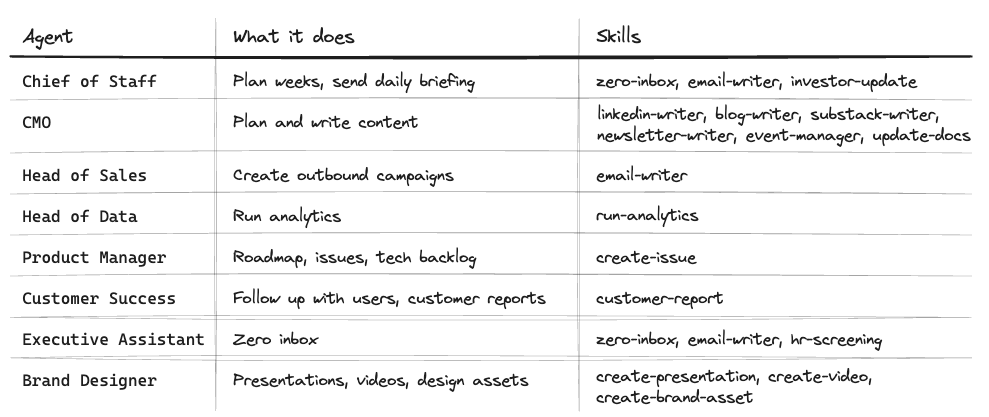
4️⃣ Scale with more skills and agents: I kept adding skills as I needed them. After a few days I added more agents to package those skills: CMO, Head of Sales, Head of data, Product Manager, Customer Success, Executive Assistant, Brand Designer.
nao-os structure
Main structure
The brain is a Git repo. Not a platform, not a SaaS tool. Something with no lock-in, that can work in Claude, Codex, you name it.
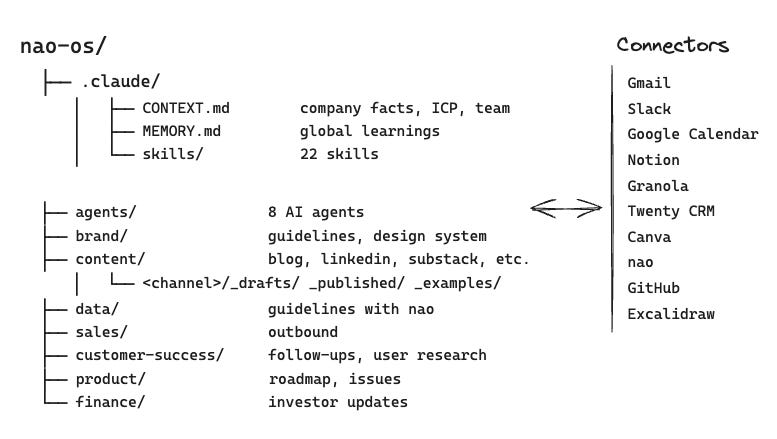
CONTEXT.md gives context on nao and nao-os: what nao is, how the product works, who the team is, who we sell to. Every agent reads it before doing anything. It also gives it orientation throughout the repo: different company domains, skills and agents.
MEMORY.md indexes what agents have learned across sessions - and that are true for ALL the company domains. For specific domain memory, I’ll just update the domain context or skills.
Domain folders record domain content. Ex: LinkedIn posts, sales presentations, brand assets, product findings, etc.
Skills describe how to use this content and the process to run actions. And agents use one or several skills to do a sequence of work.
The agent team
I built 8 agents, organized like a small team:
Connectors
An important piece of this whole set up is the connectors to our tools. I now choose only tools that can integrate with agents through cli or MCP - and preferably tools that don’t need chrome usage otherwise it can’t run in the cloud. Tools I connected: Gmail, Google Calendar, Notion, Granola (meeting transcripts), Canva, nao (our own product), Twenty, Slack, Excalidraw, GitHub.
My 6 fav use cases
1. Daily briefing (Chief of Staff)
A key step of my day has always been: prep my day & priorities in the morning. So now I have a scheduled routine in Claude Cloud that triggers the Chief of Staff every morning.
The chief of staff:
Updates me on the week objectives & tasks progress
Plans for my day: which meetings I have, which tasks I can do
Briefs me on calls of the day - with context of previous discussions with people I meet
Drafts mail answers for the important ones
Creates kanban tasks for next steps of yesterday’s calls (from Granola recordings)
Calls the CMO to update on week content progress
Calls the CPO to do a recap on our open source repo activity, review yesterday calls and create issues from user feedbacks
Calls the head of data to get main business metrics (from nao stories)
Sends the full briefing to me on slack
Pushes to the main branch to keep track of briefings
What I love: I start my day knowing exactly what needs my attention.
Time gained: ~30 min/day of morning prep
Me vs the agent: The agent gathers, structures, and flags. I make the decisions on priorities.
2. Content production (CMO)
The CMO is my most-used agent. Every Monday, it drafts a weekly content plan, according to a frequency of posts I defined. It has one skill for each platform (LinkedIn, Substack, etc.). Whenever I need to write a content piece, I send the idea and draft of the content structure, then it writes it up in a clean way. At the end, it stores every piece of content produced and learns from it.
What I love: Going from ideas to ready to ship in a few minutes
Time gained: ~20min for each content piece
Me vs the agent: I give the idea (my strength), an agent does the writing. (my weakness)
3. Analytics on demand (Head of data)
The head of data lets me answer any analytical question directly from my agents. It uses nao underneath - our company data brain. nao already has a curated context on our data, which is up to date with what’s actually in the warehouse and codebase, and which is constantly evaluated with nao test framework.
Every day, the head of data updates me on main company metrics - by pulling a data story created on nao. When I need more adhoc analysis, it can keep deep diving on the data, and can create stories for me to share with the team.
What I love: Getting fact-based analysis directly in my agent
Time gained: ~1h per analysis, 15min everyday for not checking reports manually
Me vs the agent: I ask questions, suggest analysis path, agent finds right tables and writes SQL
4. Tech backlog management (Product Manager)
The PM runs daily. It monitors issues opened by the community, suggests a priority label - this helps me stay updated on current user issues on our product. It also monitors merged PR so that I get updates on product new features and bug resolutions, and can keep up with the tech team roadmap!
What I love: I’m always up to date with repo activity, without going there
Time gained: ~15min per day of repo catch up
Me vs the agent: agent suggests issues triage, I validate
5. Meeting follow-ups (Chief of Staff + CSM + PM)
Every day, the CoS reads my Granola transcripts. It creates tasks of next steps in my kanban board, passes customer follow ups reminders to the CSM, and product feedbacks to the PM. The PM then has a skill to create issues on Github - and directly specifies issues from exact customer feedback.
What I love: I don’t write notes before, during, after meetings anymore. I’m fully concentrated
Time gained: 5-10min per meeting
Me vs the agent: agent does everything
6. Customer reports (Customer Success)
This is just one skill to get all info on one customer. This skill fetches our Granola recordings, mails, calendar past meetings, slack exchanges, twenty crm data, nao activity data, then outputs a single report on the customer.
What I love: my decentralized customer data becomes centralized
Time gained: 10min for every customer research
Me vs the agent: agent does everything
My final verdict on company brains
Today, I would not work without nao-os anymore. I saved a lot of hours and focus thanks to it.
What works well:
Data gathering tasks are the biggest game changer, those were I don’t do anything: customer reports, transcript summaries, meetings preparation, etc.
The learning loop is real. Every task I run through the brain makes it smarter - skills auto-improve, insights compound, examples accumulate.
Sharing context with the team through Git is so easy. Now we are two working on the repo, and it even helps me keep updated on my colleague’s progress.
What doesn’t work yet:
Connectors are the bottleneck. If your tool doesn’t have an MCP, the agent won’t help much - ex with LinkedIn, Luma where I still could not get context from them.
There’s no creativity. I’m still the one bringing the ideas. But I’m not sure I want that to change.
It can be slow. A customer report that pulls from 4 sources takes time. The more you prepare context ahead, the faster it gets. But here again, it’s just a different way of working - I just launch agents and come back later. You learn multi-tasking.
That’s all for today - I hope it will inspire other people to build their own company brain. I’m not sure the Github + folders + skills + agents is the best approach, but at least it’s a start and it doesn’t lock in my context anywhere.
Curious to get reactions on this - anything I can do better? Any cool company brain you’ve heard about?
Great post, Claire working on something similar myself. My twist: Obsidian as the front-end layer on top of the markdown context, so I can interact with it from mobile/desktop whit Obsidian and use Obsidian’s backlinks to make relationships between context files.
The Git repo as the knowledge layer is the right call — no lock-in, readable by any agent, versionable, diffable. The decision to choose only tools with MCP or CLI integration is equally sharp. Most people discover that constraint after they've already built half the system around a tool that requires a Chrome session.
The "connectors are the bottleneck" admission at the end is the most honest part. The brain is only as good as what it can read. LinkedIn being a blind spot for an agent helping a founder write LinkedIn posts is a meaningful gap.
I write about production AI systems and distributed backends — the infra layer these company brains eventually need to hold up under real operational load. Worth a subscribe here too.